Every once in awhile a line from a poem will drop by and stay long enough to make me want to recall more lines, remember why I was drawn to it in the first place. I had noticed recently, as I drove up the lane leading to my place on Upper Whitefish, that the trees and shrubbery left dappled sunlight along the trail. I was smitten by the play of light and so stopped to take a photograph or two.
It seems 'dappled sunlight,' or some version of it, has been turning up in a variety of places and so I went wandering into my mental archives to retrieve the place I first came across it. I knew it was when I was a teenager and that I'd loved the words so much that I'd stolen them for a poem I was writing. With much trepidation, but apparently not enough, I had used the line, "long dappled grass." You can imagine what was coming out of my feverish fifteen year old brain. Luuuve. Yes, sophomoric does come to mind.
When I went on my search yesterday, I turned up W.B. Yeats poem from which I'd borrowed the line. I realized my initial fear of larceny was unfounded and I was not on the lam from the poetry police. It wasn't so dastardly a deed. I then placed it in my mental box marked, "In homage to someone's superior talent," and forgave my fifteen year old self, the one that still lives inside of me.
As I read, I found myself pulled in more and more to his poetry and remembered many lines that I had liked at various times in my life. Some of his lines have entered into mainstream usage in one way or another. It was good to be reminded of their origin. I decided to put some of my favorite lines together this morning and see what showed up. Sort of like magnetic poetry on the fridge. It was fun. And that's the point. I love playing with words. Here it is, stolen line by stolen line. I don't think William would mind.
Horseman, pass by! This is no country for old men. Their ancient faces like rain-beaten stones. Dwelt among wine-stained wanderers in deep woods. And I shall have some peace there. Walk among long dappled grass.
The pilgrim soul in you. Slouches towards Bethlehem. Tread softly because you tread upon my dreams. Too long a sacrifice can make a stone of the heart. Peace comes dropping slow. Amid a crowd of stars.
A few days ago a friend forwarded an email with the story of a tigress whose cubs had died due to premature birth. When she became despondent the zoo decided to replace the cubs to help her heal from her grief. Unable to find tiger cubs of the appropriate age, they replaced them with...are you ready? Piglets. Piglets dressed in tiger costumes. I was enthralled with this story of how the mother tiger suckled and nurtured these piglets all the while appearing to be quite pleased with, if not proud of, her babies. Who wouldn't be? These piglets were adorable and oh-so-appreciative. And, they loved their mama.
I noticed the photos were dated from 2004, so I decided to google it and see what happened to this little family of disparate creatures. Well, the story is a bit different than the tale told 'round the web. The zoo is the Srirach Tiger Zoo in Chonburi, Thailand and this is the sort of thing it does. Matches up odd families, sort of. It does this for entertainment purposes, so I wasn't exactly thrilled to read of the zoo and its practices. It is an interesting story, though, and it does not negate the deeper implications. Snopes, sort of an internet fact-finder, which dispels rumors and urban legends, tells us the mother tiger herself was raised by a pig and so she did not see them as potential prey. They were already like family.
The story is an opportunity to look at what is possible. It begs the obvious question, why can't human beings live together in harmony? I'm not going to spend a lot of time looking at that question. Been there. Done that. Haven't we all? Instead, every time I'm tempted to get down about what appears to be the state of the human condition, I can pause to let these images come in and remember. I can choose despondency or I can choose hope.
"I believe with religious intensity that good design is for everyone."
~Russel Wright
In what might appear to be my never-ending quest for The Perfect Fort, which I have written about previously, I have been busy trying out a variety of places that might work. What I'm finding out is that many of the places I thought might work as a fort, either do not speak to my soul, or I have outgrown. I'm also finding that the places that really speak to me, my inner self, can be approached with a new perspective. Not retro-fitting. That would be going backwards. I'm talking about a whole new approach to aspects of those things that did work. That will not just work now, but will carry me forward, right into the perfect place to build a fort.
For those of you who remember "My Own Island of the Blue Dolphins," that is closer to what I'm referring. A somewhat spankier version of that place at the end of the clothesline. I visited a Barnes and Noble in St. Cloud the other day, looking for a particular book, when I veered over to the periodicals section, which I am wont to do, and, Lo and Behold! There was a magazine I felt drawn to for reasons I didn't even question. There was something about the cover story... I just added it to my ever-growing pile and marched to the checkout. Before things got really out of hand.
The cover photo was the dining room of a home created using the boulders and trees just outside its doors and windows. The magazine is Modernism and the article was "Living with Nature," a look at the home of American designer, Russel Wright (no known relation to Frank Lloyd). Although I had for the past couple of years been very intrigued by Modernism, as it applies to architecture and design, this seized my imagination as nothing else has. Perhaps I'm just finally listening and the time is approaching where this little dream of mine could finally take root.
I love the idea of living in harmony with nature, to see the outdoors clearly right outside my window and to live in such a way as would allow the outside in as often and as much as possible. The reality of building such a place in Minnesota, where snow and cold comes fairly early and sometimes hangs in there long after we're ready for its retreat, has not escaped me. Nor has the reality of mosquitoes. I'm working on that one. I believe what we see as pests in nature can be dealt with on a purely spiritual level. I am not there yet.
What I loved about this particular structure was his desire to use space wisely and in line with nature. What I did not like so much was his use of less than natural products, i.e. formica, styrofoam, plastic. These were all new and very popular in the time period in which he built his home and he wanted to create something using these new materials. He said, "My own experimental and personal country home is intended as an experiment and demonstration that contemporary design can create from old and new materials a home highly individual, capable of a variety of moods that can be found in traditional homes, a home that can join the emotional, sentimental and esthetic characteristics with the practicality and comfort that we have created in the 20th century." Taking that into consideration and understanding his approach, looking now from a new perspective early in the 21st century, my own project would perhaps include more natural if not recycled materials as much as possible. There is much I could incorporate from his vision, including his door knobs made of stones.
He and his wife, Mary, who passed on in 1952, found the perfect land in the Hudson River Valley in 1942. Construction did not start for sixteen years and was not completed until 1960. He named the place Manitoga, the Algonquin term for "place of great spirit." He built amongst an abandoned granite quarry, using land that had been decimated by copper mining and logging. His daughter, Annie, renamed it Dragon Rock, after a granite outcropping on a cliff, visible from inside the house. The background story of how he chose the building site and his approach to its design really intensified my own desire for just such a place. On a somewhat smaller scale. I love his descriptions of what he saw from his own personal space, including windows just above ground level that provided, "a worm's-eye view."
Rather than go into an in-depth re-writing of this story, I'm suggesting the link to it. If you like magazines about home design, you might like this. Unfortunately, a subscription is required to read the entire story. That's how these things work, it seems. But, if you like the idea of living in harmony with nature, if you appreciate reading about an aspect of our American heritage in architecture and design, I suggest picking up a copy. This is a good read. But, it's the photographs that really tell the story. I've always liked stories with nice pictures.
The magazine article also includes information on his other projects, such as furniture and dinnerware. His designs included pitchers. I haven't had my eye on collectible pottery and such for many years. I thought I was down-sizing. I fear I was just making room for the new. Well, the old-new. I might be able to justify a small plate...
You've got some "Star-Spangled' nails in your coffin kid. That's what they've done for you son.
~Richard Brautigan
In the fall of 1972 I entered college at Bemidji State. It was not yet part of the university system, but just a small state college set amongst the trees which lined the shores of Lake Bemidji in northern Minnesota.
The Vietnam War was still raging, Watergate was just coming to light but had not yet entered our lexicon as a term for all manner of political mayhem. I was a young wife and mother who was harboring visions of becoming part of something bigger than what my then small world seemed to offer. In the late sixties I had very quietly fantasized about joining the Weather Underground. I didn't spend a lot of time considering the violent and sometimes lethal road it had taken. Nor did I understand the completely antithetical nature of such an organization. I was naively interested in railing against the system, protesting the powers that be, and in particular the war that had permeated our consciousness taking thousands upon thousands of young lives.
Three years previously I had grieved with my best friend as we heard over the school intercom, while in home economics class, that her sister's boyfriend, a former student at the school, had died in Vietnam. I knew Max only slightly, but that day we grieved for more than Max. We grieved for something lost, something indefinable and yet torturous in its implications.
In the fall of '72, I looked like a cross between a hippie and a leftover beat poet from the fifties. One day I was in India cotton and sandals, the next it was a black turtleneck and bell-bottoms with cowboy boots. I was not in the throes of an identity crisis so much as I was just a young girl who was simply trying on all the possibilities that spoke to me. Inside, however, beat the heart of an anarchist. Two things kept me from acting on this. Family and Fear. I had already positioned myself as the black sheep in a family that didn't wander too far outside the mainstream. I was also afraid of the system which I so longed to change. It was quite simple. I didn't want to hurt anyone. And I loved my freedom.
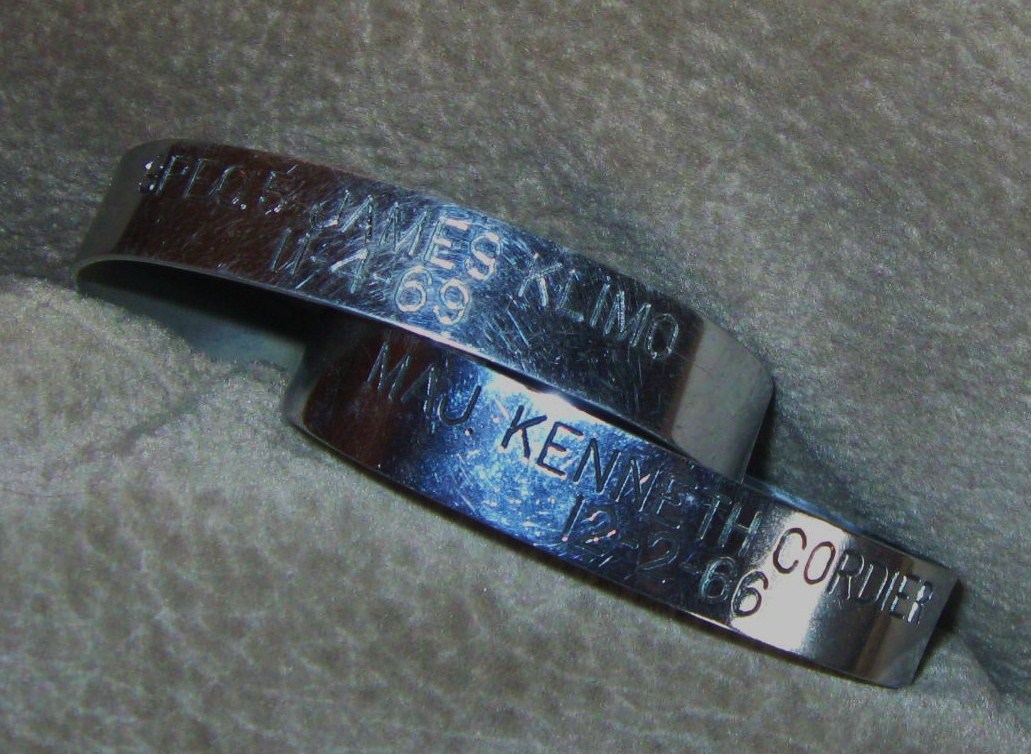
My first week in college I had no intention of entering the fray of politics and protest. It was a quiet time, there on the shores of the lake, when I leaned over to the gal sitting next to me in an English class and inquired about the bracelet she was wearing. It was a nondescript silver band with writing on it. She explained that it was a POW-MIA bracelet. They honored soldiers who had become prisoners of war or were missing in action. I immediately wanted one. It wasn't a fashion statement, I just knew I had to have one and that something else had been set in motion. She gave me the phone number of a woman who was spearheading the local movement to sell these bracelets and bring this more and more to the attention of the public; a public that was growing weary of a war that was just starting to see the light at the end of a very dark tunnel.
I called the woman. She invited me over to her house. We sat and talked about the bracelets and how I could sell them on campus. It was not the form of protest I had in mind, but it was something I could do. I didn't know it at the time, but it spoke more directly to my truer self; the self that can quietly protest as a participant in life rather than live with ill-considered decisions. She gave me the information I needed to do this.
I went back to school that next week and inquired about how to get permission, a requirement there at the college. I met with Glenn, the organizer of such events and he suggested I become president of The Coalition of Concerned Students, an almost defunct organization under which I could operate. It sounded like more than I wanted to get involved in, but he assured me it could be as involving as I wanted it to be. I then met with a man named Chick, who was president of the student body, explained to him my little plan and away I went. I received the bracelets under the auspices of the national organization, organized a meeting for interested parties, and set up a table just outside the student union, the place where everyone showed up sooner or later to hang out, grab a bite to eat, or do some last minute cramming for an exam. Three people from the meeting helped sell bracelets, each of us according to our class schedules. Like most things it got off to a slow start but it picked up a little bit of steam and we were off and running. I couldn't tell you now how many we sold but it was several hundred. As we sold them, I sent money orders back to the national organization to keep the fires stoked and us in bracelets.
We received coverage in the student newspaper with my picture and a story told from my youthful perspective. Our goal was to bring this to the forefront of people's minds, bring a greater awareness to a heartbreaking aspect of the war and to honor those who had entered a war either by what I saw as a misguided choice or by an even more misguided draft, which had resulted, for them, in horrific consequences. The week the story appeared I was approached by a childhood friend who said she'd attended school there for four years with nary a bit of notice and I was, "of course," in the student newspaper the first month out. It was my first glimpse into how others saw me. And, it was the first time I felt my inner life recognized by someone other than me.
The Coalition of Concerned Students went on for awhile, but my desire for involvement waned as the war ended and although much needed to be done for those who were still prisoners of war and missing in action, my life went in other directions, mostly concentrating on my small family and my education. As much as I loved learning, I still had a lot to learn about myself. Eventually, I put my two bracelets in a jewelry box and there they remained.
For a reason I cannot call up today, yesterday this came to mind and I found myself wondering about these bracelets again. I needed to be reminded. I found a link that provided a history and additional links where one can find out what happened to those whose name appeared on an individual bracelet. It was helpful in recalling these events and in remembering my initial desire to act outside my own little sphere of thought.
My two bracelets bear the names of Spec. 5 James Klimo and Maj. Kenneth Cordier. Kenneth Cordier went on to fill a slim role in the last Bush administration acting as an advisor on a veteran's steering committee. He also participated in the Swift Boat Veterans for Truth campaign which sought to discredit Senator John Kerry during his bid for the presidency. And that's all I'll say about that.
It sometimes feels as though we suffer from collective amnesia, both short and long term, forgetting that American citizens are still fighting in other countries for causes none of us truly understand and most don't agree with. While still living in Santa Fe, I made the decision to end my near Luddite ways and enter the spooky world of technology via computers. The local internet company sent out a technician to set up my service. We visited a bit as he went about his business. He shared with me that he was a disabled vet who had lost much of his lung capacity. He said he had served in Iraq twice and once in Afghanistan. He would not, because of his injury, be returning with his unit to yet another tour in Iraq. Tour, what a ridiculous word to describe what they are called to do. Interesting, isn't it, how the war machine, the military-industrial complex, has hijacked positive terms for far less than positive reasons? It puts a velvety little spin on their widespread shenanigans and the true cost of war, the lives of real people.
This man did not have a favorable opinion, shall we say, about our then president, Mr. Bush, and what appeared to be his complete inability to put a human face on war. This man was bitter. But, he also had a quiet and very nice energy that was palpable to me. I found myself crying as I talked with him, hearing a brief version of his story and his feelings around what was happening in our country. As he left that day, he turned at the top of the driveway and flashed the peace sign. I was left to think about the many who are not just physically maimed by war, but those who bear the silent and almost unbearable psychic scars caused by what they've seen, what they've endured.
I don't know why this story came forward today, why I feel called to write it down, but I would like to share a video with you about the reality of war. It does contain some graphic images, but it is accompanied by music that speaks to our hearts and souls, our "better angels," as Lincoln called them, and gives us hope. We should not turn away from these images. In doing so, we lose sight of how important it is that we make changes in how we deal with our global community, a community with whom we may not always agree, but with whom we must find common ground, a common ground that does exist if we take the time to see it.
I hope you will watch, and even more important listen to, what I see as the only approach to this story, a story old as time. I don't mind being called naive. I think these times call for naive hearts to step forward and claim for the world not only what is possible, but essential.
How many times are we going to pose the question, "If not now, when?"
Spec. 5 James Robert Klimo, from Muskegon, Michigan, began his tour of duty in South Vietnam on November 3, 1969. On November 4, 1969, he and three others were returning to base when the helicopter they were in ran into trouble, apparently not hostile in nature. An extensive six day search revealed nothing. His status was changed in 1978 from MIA to "died while missing." His name is on The Wall: Panel 16W Line 030. He was 19 years old. It was his second day "in country." His body, along with those of his fellow crewmembers, is still missing...
This was a wonky week. It was a week of letting go, letting go, letting go. Not an easy thing to do sometimes. What was I letting go of? Oh, a bit of preconceived notions, thoughts and feelings that needed updating, seeing things with less than clear vision. The usual suspects. I felt as though I was out on blue water, in a very small rowboat. Unsettling, to say the least. The French writer, Andre Gide, said, "One does not discover new lands without consenting to lose sight of the shore for a very long time." There in my little rowboat, I wondered, how long will I be out here? How long before I arrive?
I thought about these little islands of beauty I find myself on. They are fine places to be, beautiful places to be, but they are temporary, a place to rest for awhile, but they are not a destination, a place to say, 'I have arrived.' Yesterday, as evening approached, I went for a walk along the ridge overlooking the lake and realized I had to re-frame the questions. Arrival is not my goal. Destination is not my goal. Moving through life, going with the flow, is all there is.
In the morning, visiting with a friend on the phone, we had jokingly talked about the search for meaning in life. He suggested I reduce the parameters of my search. He added, "Too much looking is going to lead you to the rock pile." The rock pile, I asked? "Yes," he responded, "The one Virginia Woolf went to before she took a walk in the water, her pockets filled with rocks." I reassured him I was not anywhere near a rock pile and had no intention of finding one. But, for a moment, my mind went to Ms. Woolf and the unendurable place in which she must have found herself. I am not there. I trust I will never be there. I know that meaning must be found in the day to day of life, the small moment, the tiny and fragile bits of life that tell us the world is, indeed, a kind and loving place.
The day before, I bought a book of prose and poetry by May Sarton at the local used book store, a book in which similar questions were posed, questions about the nature of solitude and finding a balance between that and loneliness. Ms. Sarton said, "At any moment solitude may put on the face of loneliness." Not helpful, May. But, she does say some things that are and which make me feel a kinship with her. Such as, "Solitude itself is a way of waiting for the inaudible and the invisible to make itself felt. And that is why solitude is never static and never hopeless." She goes on to say, "The metaphor that comes to mind is that of a sea anemone that has been wide open to the tide, and then slowly closes up again as the tide ebbs. For alone here, I must first give up the world and all its dear, tantalizing human questions, first close myself away, and then, and only then, open to that other tide, the inner life, the life of solitude, which rises very slowly until, like the anemone, I am open to receive whatever it may bring." Being open to receive whatever it may bring has been my modus operandi for...awhile now. It's sometimes exciting, sometimes scary, always interesting.
These, however, are the words that solidified, for me, my sisterhood with May: "There is no doubt that solitude is a challenge and to maintain balance within it a precarious business...We are lonely when there is not perfect communion. In solitude, one can achieve a good relationship with oneself." Achieving a good relationship with oneself. Amen, sister.
And that was my challenge this week.
May Sarton passed on in 1995, but I want to say, Thank you, May, for the wise and nurturing companionship your words brought me. The world is, indeed, a kind and loving place. The sunlight, glistening on the leaves of the birch outside my window, tells me this is true.
It's late evening on Whitefish. A few minutes ago, I picked up the phone to call my son, Coleman, to thank him again for the great visit here this morning. He said he was just reaching for the phone to call me and let me know that the sunset was worth checking out. Earlier this morning we sat outside on the grass overlooking the lake and talked about life from pretty much every angle. As we did so, we were entertained by the local wildlife. A red-tailed hawk flew over the lake in front of us, not once but twice. Coleman commented that he'd seen one over at his dad's house recently and later, that same day, he'd seen one sitting on a utility pole near his house many miles away. Shortly after the hawk, a trio of Canada geese flew by, serenading us with their honking. Then, a loon popped out of the water, calling across the morning.
The sunlight felt so kind and good, warming the place where we sat. We started talking about how a song can show up at the oddest and most interesting times, offering a message of reassurance. Unbeknownst to Coleman, for several years the Beatles, "Let It Be," has done just that. It goes back to the day of my mother's funeral in February of 2000. I have mentioned before that it was a very snowy day, the only real blizzard that winter. At the graveside service, as we each had finished placing a rose on top of her casket, my brother Jerry's oldest son stepped forward and sang, a cappella, "Let It Be." He has a wonderful voice and it was a sweet and unexpected gift. I asked him about it later and he said that as he was getting ready to leave Denver for the funeral he just knew he was supposed to sing it at the funeral, graveside. It was a beautiful moment under the green canopy with winter in full force.
Five years later I was sitting in the Albuquerque airport waiting to catch the early morning flight back to Minnesota for my dad's funeral - he had passed on the day before - when a father and son walked into the almost empty waiting area and sat just two seats down from me. The teenage son was wearing a t-shirt of the Beatles album, "Let It Be."
It began showing up with some regularity from that point forward. I was driving across Pennsylvania last fall, en route back to Minnesota, when it came on the radio. I started paying attention and knew I was supposed to exit. I found myself crossing two lanes - safely mind you - and exited to see a Comfort Inn almost hidden in the woods that surrounded this small town below the interstate. I pulled in just before dark and found I had earned travel points worth a free night's stay.
As we sat talking, Coleman said he heard a song on the radio as he was driving over this morning that seemed to be speaking to him. I asked which song and he replied, "Let It Be," by the Beatles.
It's May 7th and it's snowing outside. I'm looking out on Upper Whitefish Lake, here in north central Minnesota. Part of the Whitefish chain of lakes, it's one of the prettiest lakes in this land of 10,000 or so. I just scored a really nice condo for rent at off-season rates for the next six weeks. I will continue to keep my antennae up for possible land or dwellings that say, "You've come home." In the meantime, it's a good place to be. It's down the shore from where I once lived, but the view is different so it feels brand new.
I can see Indian Island from my deck. It's a small island with some history to it, both Native American and personal. I've been out there many times in years past, waded in the back cove, picked Indian Paintbrush and walked through a grove of old growth trees that felt as though I was in the finest cathedral in the world. If spring ever arrives in full regalia, I will probably find a way to get out there again and I'm looking forward to it.
There are big Norway pines alongside the deck and on the grounds, and only one neighbor. Everyone else is waiting for summer to show up, for which I'm very grateful. At the risk of sounding selfish, it's nice to have such a lovely spot almost to myself. I slept last night in a loft, with a king size bed made of logs, in a sweet and peaceful place.
One year ago today I posted my first blog. What started out from Santa Fe as music and movie reviews, with some metaphysics thrown in, has evolved into something quite different than I originally imagined. Both the place and the postings. Each time I sat down to write, something else emerged. It was as though my blog had its own ideas, its own plan for how this was all going to go. Some mornings, while still lying in bed, lines would come in and I knew I had to get up and get them down, there was an idea percolating that wanted to be expressed. Sometimes, I was completely surprised by what showed up. I sat down and watched the ideas spill out. Other times I assisted a bit more as I worked through an idea, waiting patiently, more or less, for it to be realized. I never intended to get into reminiscing about the past, but some of my stories had been waiting years to be told, like "An Old Black Van and a Ripe Yellow Pear." And there they were, all dressed up in colors and imagery, ready to go.
It's been a good year for self-discovery, a constant unfolding. Perhaps a tad nomadic, pulling up camp every few months for other pastures and other possibilities; all springing from my deep desire to more fully understand our connection to each other.
I'd been thinking for some time about community, how we create community, how we sustain it, how we find the right people to share it with, people that have similar, yet diverse, outlooks. When I first mentioned this to a friend from Santa Fe, he said it sounded good, but we agreed we didn't want to spend any time sitting around the communal table and discussing who burned the beans. We both like our privacy, our quiet alone time, but want to feel supported in life, as though there is a group that listens and cares, understands and accepts.
For the first few months, I blogged only for myself. And that was fine. I love the process of writing. As the months rolled by, a few visitors stopped by my blog and then decided to pay regular visits. I visited their places, too. A community was born. A "society of friends." I could not have gone out and recruited a finer group to commune with, to share my life with. We have created, what is for me, a support system of love and caring out of what might first appear to be total strangers. But we know better. And as our community of souls expands to embrace a world we love, each of us, in our own way, is helping to make it a really fine place to be. And no one is worrying about who burned the beans.
I bring to you, for your listening and viewing pleasure, "Sgt. Pepper's Lonely Hearts Club Band," from The Beatles film, "Yellow Submarine," just because it's so darn cool. Have a beautiful day, my friends, my family. http://www.youtube.com/watch?v=JOO8-Jp-xsg
It seems unfortunate that the phrase, "You can't go home again," has become so firmly embedded in our collective consciousness. When Thomas Wolfe wrote his novel of the same name, he said at the end, "You can't go back home to your family, back home to your childhood...back home to places in the country, back home to the old forms and systems of things which once seemed everlasting but which are changing all the time - back home to the escapes of Time and Memory." Yes, the old forms and systems of things are always changing and escaping into time and memory is never a good idea. But, we are also changing and I believe we can always approach our past with fresh eyes, with a new perspective and out of that can emerge an entirely new body of experience that speaks to our new selves. It's not about returning to the past. It's not about getting stuck in the past. It's about moving forward into familiar places with a willingness to see things differently, recognize those places where a new attitude and a new outlook could bring healing and even regeneration. And sometimes, it's just nice to be home, to return to a place that feels right. We cannot buy into ideas that someone else puts forth and let it become our truth. We have a right if not a responsibility to test those notions before we accept them.
Returning to Minnesota feels right. I'm finding that what once seemed like a stultifying atmosphere has expanded. I have grown and thus I see growth all around me. In this little town of around 800 people, there's now a hatha yoga studio on the main street of downtown and a farmers market during the summer. As I open my eyes I'll see more and more. This old world is expanding from a boundless basis and a limitless horizon right here in the middle of Minnesota, the land of 10,000 lakes. It's a place of growth with a full range of all that nature has to offer. I look forward to seeing what my old but ever new home has in store for me.
That's me on the right, in the striped dress, with Jane, and our brother, Jerry. My kitten handling skills have vastly improved.
My time at the ocean is drawing to a close. This will be my last post from my hermitage by the sea. As with most things in life, it's from a distance that the story will begin to reveal itself. I'm so grateful for the opportunity I've had to see life from a fresh perspective, to listen to the sea, to stay present to each day and what it offered. Large lessons have been learned and I look forward to seeing what will be revealed to me as I move forward.
When I first arrived in Maine, about six weeks ago, I thought perhaps I would stay, explore my life from this new place. As the weeks unfolded, I knew that would not be the case, that my time here was limited. Last summer, while still living in Santa Fe, I returned home to Minnesota for a visit. Shortly after arriving, I knew, with a deep inner knowing, that I was to return to Minnesota, the land of my childhood. I was to put down roots and make a life there. But, before I could do that, I apparently had unfinished business I needed to attend to. Unfinished business with myself. I needed to gain a greater sense of peace, to discover my center, to learn to put my whole self in my life; riding fences would no longer cut it. It simply wouldn't be allowed. I had to move forward on a sure basis. I cannot imagine having a more perfect place from which to do this.
I'm going to miss falling asleep to the sound of the waves against the shore, and the train, the Downeaster, passing through, just a couple of blocks away. Waking up to the sun glinting off the water, brewing morning coffee, then sitting down to write at the kitchen window that overlooks the ocean. Nothing but sky and ocean for thousands of miles.
It's been wonderful.
But, I've been getting that prompting, that inner knowing, that it's time to return to Minnesota. I'm anxious to get my hands in the earth, to garden, to plant flowers, to find a chunk of land and carve out a life, a more self-reliant life, that speaks to my truest self. Perhaps something akin to my farmhouse in Ansel but smaller, more efficient. A New Ansel. That sounds good. Very good. We shall see what unfolds.
I mentioned to several people, and in my writing have alluded to it, that I felt the presence of my mother here at the ocean. My niece, Tanya, surprised me with a phone call just as I walked onto the beach one day. She said, "I have always felt that Grandma went to the ocean when she passed." Mom loved being near the water. She visited the east coast right after high school. There's a photo of her standing alongside a railing on the Atlantic City boardwalk. I have no doubt that I've had her loving support during this odyssey. It did not seem at all odd that Tanya would affirm this for me. She often has very strong intuitive thoughts.
While walking on the beach a couple of weeks ago, I saw two words written in the sand. You might recall my previous post in which I found letters in the sand spelling "Love is Beautiful," just down the beach a ways, and posted a photo of it. This time, I stopped to read, but was too preoccupied to pay full attention. It was not until an hour or so later that I knew I had to go back down and see if the letters were still there. I wanted to photograph them. They were large letters, so I wouldn't miss them. They were there. It took two photos. These were the two words:
Yesterday marked the passing of Samuel Langhorne Clemens. As you probably have heard, he came in on the tail of Haley's Comet, November 30th, 1835, and left seventy five years later, on April 21, 1910, the day after its return. Which is pretty cool, I think. I've been a Mark Twain fan for a very long time and have come to love his often acerbic wit. He had his finger on the pulse of human absurdity and was never afraid to tell it like it was. And is.
Lest we feel our current Congress is failing to show any signs of intelligence, divine or otherwise, perhaps we can find some small solace in knowing that story is not new. Twain has been quoted as saying, "Reader, suppose you were an idiot. And suppose you were a member of Congress. But, I repeat myself." His feelings towards those who call themselves patriots is equally telling and seems to have stood the test of time: "Patriot: the person who can holler the loudest without knowing what he is hollering about." Another one of my favorites, though I probably shouldn't admit it, "The trouble ain't that there is too many fools, but that the lightning ain't distributed right."
When I was in college, lo those many years ago, I was fortunate to be able to take an entire class devoted to Mark Twain. I read close to everything he had written and came out of it with a brand new favorite book, Roughing It. It remains to this day among my favorites. I wish I had a copy in front of me so I could quote from it but taken out of context it might lack that flair he had for sarcasm. His description of the waystation the stagecoach stops at as he traveled out west, is, for me, some of the funniest writing ever. Don't know why but it always makes me laugh 'til I cry. There are lines in that book I still like to drop in conversation every chance I get. It doesn't happen often.
The Adventures of Huckleberry Finn, will always remain one of the greatest books ever written. I read it out loud to Coleman when he was about ten. Yes, he could read very well for himself but it was a nightly ritual, a chapter or two before bed. He recently wanted to buy a copy and re-read it. That certainly did my heart good. I read out loud to both Coleman and Trevor. It started before they were born. I hope parents still read to their children. Not many things finer.
Twain did not shy away from tough subjects nor was he afraid to do battle with the powers that be. He rode in well armed. He knew that humor comes more often out of sorrow than happy times. And he had more than his fair share of sorrow. He said, "Against the assault of laughter, nothing can stand." I was able to see Hal Holbrook in his one man show on Twain several years ago in Albuquerque. I had wanted to see it for some time. What a treat.
Ken Burns did his usual outstanding job with a PBS show on him several years back and a great book to go with it. It is chock full of interesting images and the accompanying text is very well-written, Mark Twain: an Illustrated Biography. If you're a Twain fan at all I'd suggest getting your hands on this book. I sure hope the film comes around to PBS again.
Twain loved cats. He had many lounging around his home and offered this observation: "If a man could be crossed with a cat, it would improve the man, but it would deteriorate the cat."
From A Tramp Abroad: "You may say a cat uses good grammar. Well, a cat does -- but you let a cat get excited once; you let a cat get to pulling fur with another cat on a shed, nights, and you'll hear grammar that will give you the lockjaw. Ignorant people think it's the noise which fighting cats make that is so aggravating, but it ain't so; it's the sickening grammar they use."
I have a slim volume of the best of his witticisms. I often go there when I need to be reminded that it's important to keep a sense of humor, to find the silliness in the human condition. And silly it can be. Silly and beautiful. At times it seems like we are all just flailing around trying to figure it all out. Well, at least I am. Maybe that's the great gift of the sea for me, to learn how to be still. It might seem rather disparate but I believe everything is connected, so here it is, my real lesson from Mark Twain and perhaps my favorite song by the Eagles, "Learn to Be Still." It has some nice images, and it does show the lyrics, but I suggest, at least once, just close your eyes and listen.
Note on Jan. 9, 2013: There are no longer any videos of this available so I have substituted with the lyrics:
It's just another day in paradise
As you stumble to your bed
You'd give anything to silence
Those voices ringing in your head
You thought you could find happiness
Just over that green hill
You thought you would be satisfied
But you never will-
Learn to be still
We are like sheep without a shepherd
We don't know how to be alone
So we wander 'round this desert
And wind up following the wrong gods home
But the flock cries out for another
And they keep answering that bell
And one more starry-eyed messiah
Meets a violent farewell-
Learn to be still
Learn to be still
Now the flowers in your garden
They don't smell so sweet
Maybe you've forgotten
The heaven lying at your feet
There are so many contradictions
In all these messages we send
(we keep asking)
How do I get out of here
Where do I fit in?
Though the world is torn and shaken
Even if your heart is breakin'
It's waiting for you to awaken
And someday you will-
Learn to be still
Learn to be still Thank you, JB, for reminding me...
I been thinkin' about time. There's a wonderful little book called Einstein's Dreams, by Alan Lightman. Each chapter represents a dream that supposedly helped him develop his theory of relativity. It's fiction, of course, but it's a really cool idea. I wish I'd thought of it. I find it a fascinating little compendium of possibility.
For example, one of the chapters deals with a village in which those who live higher up the mountain experience time entirely different than those who live down at the bottom. In another scenario, everyone begins each day again, as though it's the first day, a group amnesia sort of thing. Then, there are those who repeat their lives over and over again with only minor variations. Not-So-Instant Karma meet Groundhog Day. And, there are those who are destined to repeat their lives over and over again with absolutely no variation, not even a gesture. I refer to that as the Vicious Circle. I love this book. And I love looking at time, all the possibilities. For a long while, I've been seeing time as a simultaneous thing; everything is happening now, in this moment, but we are choosing to experience it in a linear fashion. For reasons known only to us. Apparently. I haven't got all the kinks worked out yet, only been workin' on it for about forty years. But, it's sure fun to look at and I like to think it has helped me to better understand human nature, at least my own. Hopefully.
A few weeks ago, a friend and I were talking about our mutual appreciation for Leonard Cohen and his CD "Ten New Songs." His voice has become so rich and deep. A wonderful group of songs. Anyway, he was trying to remember a particular song from many years ago and I thought it was "Suzanne," by Leonard Cohen. Turns out it wasn't. So he sang a few bars for me, to see if I would recognize it. And I did. It was, "Joanne," by Michael Nesmith. He was one of the Monkees, my favorite Monkee, as a matter of fact. The quiet, thoughtful one. When I hear his song on the radio, time stops, I listen.
A couple of days later, I found a youtube video; a musical/photographic tribute to Joanne Woodward and Paul Newman, with "Joanne," as the theme song. It's a paen to love itself. Those two lovebirds are pretty much the coolest couple to ever grace this planet. I bought some Joanne Woodward paper dolls at a Five and Dime in a suburb of Minneapolis, way too many years ago. I wanted to be her when I grew up. Alas, that did not work out. Paul, now gone, lovingly referred to her as "one of the last of the great broads." She still lives in Westport, Connecticut. This is my favorite photo of them.
I"m not sure what that has to do with time, but it seems to have everything to do with it. I hope you enjoy the video and not just for Paul and Joanne, but for Michael Nesmith, one amazing songwriter and I'm betting a pretty cool guy. His song is beautiful. His voice is thoughtful. I like his energy and I've never even seen him in person. Some people just feel good, even from what seems to be a long distance. Like Paul and Joanne.
Note on Dec 12, 2021: I revisted this post after Michael's passing and found the video of Joanne using the Paul and Joanne images is no longer available, so I've replaced it.
When you leave the area called Oxford Hills, up north of here, there's a road heading even further north that leads to some pretty wild country. It reminds me a great deal of Canada, at least the parts of Canada I've been to. Pine trees and rocks. Lakes with islands. And roads that appear to be in perpetual need of repair. The kind of place where a person could get lost.
There's something about Maine that causes me to get disoriented easily. It's all that talk about downeast. Which isn't down east at all. It's a maritime term, having to do with water, wind, stuff like that. Down East is heading up. East. I think. I'm pretty good at reading road maps. I said, 'pretty good.' And getting my bearings, direction wise, isn't a problem. But, driving the back roads here is like trying to find my way out of a maze. I usually know where I'm going, I kinda know how to get there, it's the in-between part that can get interesting. I'm learning to relax, though, knowing I will arrive someplace and from there I can take another leap into the unknown.
The other day, I decided to head out and see what the insides of Maine look like. I felt a bit like that youngster, I'm tellin' this story, who heads out to stake a claim in the wilds of the new frontier. Threw a pack across my horse's back, put my foot in the stirrup and into the wild blue yonder I went, armed only with my camera. Okay, it was just a little day trip, in my blue Nissan, but it felt kinda fun, like a mini-adventure. Johnny Horton's "North to Alaska," started running through my mind. Much better than the last song that wouldn't let go. Some maudlin thing by Bread (I believe that may be redundant), about some dern diary: "I found her diary underneath a tree, and started reading about me..." To make a tiresome story short, turns out it wasn't about him. Anyway, here's something better, with images of the Klondike Gold Rush. Love the movie with John Wayne. Love the song. Here's Johnny Horton: http://www.youtube.com/watch?v=JSt0NEESrUA
First stop was Coos Canyon, a river much like those along Highway 61, on the north shore of Lake Superior; small waterfalls in rocky steps flowing under a rather picturesque bridge. Did I mention rocks? Lots of big rocks. It took me by surprise and was a nice way to begin.
My cell phone went into "searching for service" mode, but I stayed cool and settled into the sense of isolation. It felt good in its own way, the old way. Much of my life has been spent on back roads with nary a communication device in sight. I could do this. I soon found myself in the middle of nowhere. And have the sign to prove it. Sometimes the sign said, "next three miles," sometimes it said, "next seven miles." You get the idea.
I passed a small lake that was still mostly ice-covered. The blue sky reflected in the ice, and the stillness, the absolute quiet, kept me there for a good while, listening to the "sound of silence."
Next, "the long and winding road" (don't stop me, I'm apparently on a Golden Oldies bender) took me right to the top of this back country. It's referred to as Height O' Land, in these parts. I got outside and walked over to the edge to take a gander. Not too shabby.
I hung out there for awhile, at the top of the world, before I wound my way back down and into rolling hill country, right up to the old farmhouse I'd been tracking all day. As you know, I brake for old farmhouses. And this was a good one. I pulled over to the side of the road and got out to take a few pictures. Alright, more than a few. I was on a roll. Which would make a good pun in the old days, when we still took pictures with film. Anyway, you might think it looks familiar and you would be right. A photograph of it, a much better version, taken by Murad, was included in my post, "Murad Sayen and the Gift of Light." Ever since I saw his photo, I'd been wanting to see this farm in person. It looks like a place I could call home. When I came around the corner and topped the hill, there it was. For me, it's the roofs , the outlines formed by the houses and barns, that draw me to these aging beauties. This roof is especially nice. I've posted a photo at the top. Then, another photo of it below. And then another. And yes, I seem to have a thing for this farmhouse. As I drove away, it called me back to take its picture from the other side.
So, I was pickin' up a little bit of steam, gettin' in the groove, when I came, possibly careening, around a corner and found myself smack dab in the middle of an old mill town. Well, the remnants of it, anyway. It was there I met the coolest old ramshackle building sitting next to the river. It was quietly waiting to have its picture taken. And I happily obliged. I may have gotten carried away. It may have even started to feel like I was invading its space. It's kinda fun to view everything as alive, to feel the life that once existed inside the walls of those earlier days. It was probably a pretty busy place once upon a time. The fading turquoise window and door frames grabbed me first. I'm not sure why I find peeling paint so attractive, but I do. Especially in this color. The play of light created interesting shadows and the mottled paint around the window was, uh, appealing.
As I drove through the day, I saw a variety of social landscapes, shall we say. Have you ever read the novel, The Beans of Egypt, Maine, by Carolyn Chute? I believe I may have passed their place. I started thinking about poverty and the so-called "under-privileged." What an ill-fitting way to describe those who eke out a hardscrabble existence, with no privileges whatsoever. It's a way of life that settles in for some and finding a way out becomes difficult, if not impossible. I don't like to use those words, because I like to think anything is possible. And, I truly believe it is. But then, I've never gotten trapped by life choices, nor by life circumstances. At least, not for long. Some folks do. I had to wander about the person who had inhabited this dwelling. Maine winters can be tough. Definitely a scaled down version of a summer place. But, man, did I love the colors and the car. What a first-class photo opp. Well, it would have been, given the right time of day, the right light, but what the heck, I shot them anyway.
Later in the afternoon, I landed in Farmington, a small, picturesque college town. I've always loved the vibe of college towns, that youthful energy that moves down the sidewalks and fills the halls of academia. It seems like yesterday that I walked out of my house, just off Beltrami Avenue in Bemidji, headed down the sidewalk to the college three blocks away, saying to myself, 'These years will go by fast. Make 'em count.' That was back in 1972. May I repeat that for anyone younger who might be reading this? These years will go by fast. Make 'em count. And not just the years, but the days out of which they're made.
There was the usual library. Except in this case, it wasn't usual. Someone had the good sense to create new architectural elements to compliment the old. It worked beautifully. I have to show you a few photos to do it justice. Well, as much justice as I can, given the time of day and a pocket camera. I may have gotten a tad carried away. I love libraries. Variations on turquoise seems to be another theme here.
The bell tower of a church is a photographic cliche, but I include it anyway. I love the variety of designs in the wood, a little bit of Queen Anne, a little bit of gingerbread. There's something about how they reach toward the sky that I still find, well, uh, inspiring, that makes me want to stand under them and just look up.
I walked a portion of the main street, ducked into Dunkin' Donuts for a too-late-in-the-afternoon iced coffee and then hit the road again. I had driven a loop through some interesting country and was back on Highway 95, heading for Old Orchard Beach and home. The freeways and turnpikes might take us where we need to go, but it's on those back roads where life is really happening. Another good day behind the wheel.
P.S. The next morning I got down to the beach in time to witness this. So beautiful, it almost broke my heart.